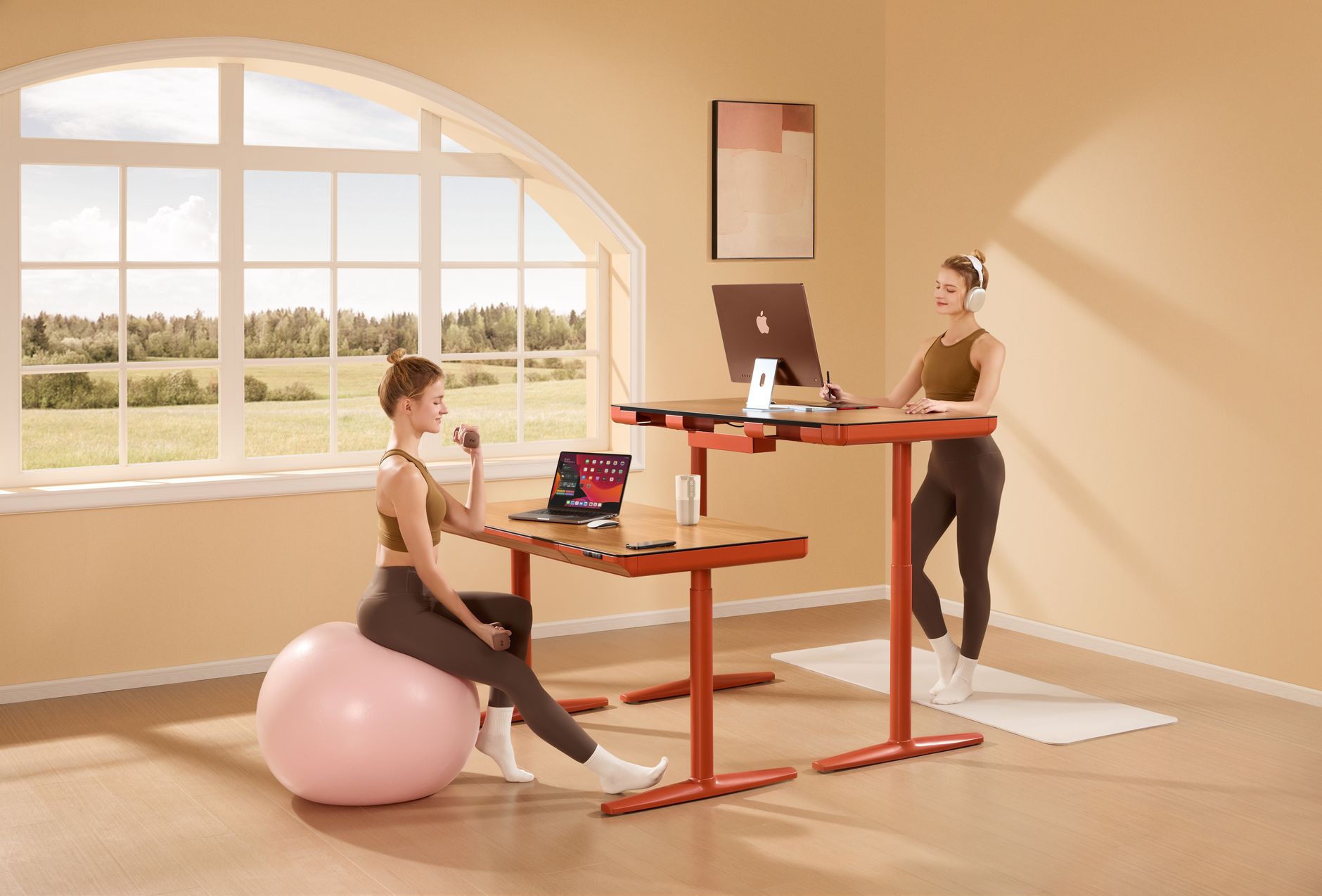
A standing desk only solves half the problem. The moment you raise the work surface and lock your knees, the load shifts from your chair to your feet, and a hard floor stops being a neutral surface. The Occupational Safety and Health Administration treats prolonged static standing as a hazard in its own right and points to anti-fatigue matting as one control among several. Standing desks sold in 2026 rarely ship with a mat, which means most people stand on hardwood, tile, or a thin rug and wonder why their heels ache by 2 p.m. The mat is the part of the setup that decides whether standing feels good or punitive.
We spent three weeks rotating six mats under the same 30-inch-deep electric desk, standing in two-hour blocks, and recording what actually changed. The comparison below ranks them on seven things: total footprint, thickness at the highest point, core material, edge taper, surface texture, how well each one prompts movement, and how easily it wipes clean. Movement matters more than softness. A flat half inch of memory foam feels pleasant for twenty minutes and then becomes a place to stand still, which is the exact failure mode that sends people back to their chairs. Before you buy anything, walk through our how to set up a standing desk correctly guide, because mat choice depends on your desk height and your shoe choice.
Standing is not automatically better than sitting. The Cornell University Ergonomics Web has argued for years that the goal is variety rather than a permanently vertical posture, and that static loading is static loading whether your hips are flexed or extended. That framing changes what you should buy. A mat is not a cushion that makes standing survivable. It is a tool that makes position changes cheap, so you can alternate between heel raises, weight shifts, and a brief sit every 30 to 45 minutes without thinking about it. If you are still choosing the desk itself, our best standing desks of 2026 roundup covers height ranges, stability, and motor speed.
Two mistakes dominate first purchases. The first is buying the thickest mat available and discovering it feels unstable, especially over carpet. The second is buying a flat kitchen mat and expecting it to do a job it was never shaped for. Mats built for a standing desk usually include one or more raised zones so your feet land in different places without conscious effort. Pair one with a footrest for the seated half of the day, and our best footrests guide covers the under-desk side of that equation. Also worth reading before you finalize the room: home office ergonomic mistakes that cause neck and back pain.
How Do the Top Options Compare?
| Mat | Best For | Thickness | Core Material | Footprint | Price |
|---|---|---|---|---|---|
| Ergodriven Topo Mat | Active standing with constant weight shifts | 1.2 to 2.2 in | Molded polyurethane foam | 26.2 x 29.4 in | Check price |
| CubeFit TerraMat | Balance and micro-movement training | 1.4 in at bars | Polyurethane with anti-slip base | 24 x 20 in | Check price |
| ComfiLife Anti Fatigue Floor Mat | Tight budgets and shallow footwells | 0.75 in | Memory foam with textured vinyl top | 20 x 32 in | Check price |
| Sky Solutions Sky Mat | Buy once and stand for years | 0.75 in | Closed-cell PVC foam | 20 x 39 in | Check price |
| Imprint Cumulus9 Nouveau | Long, uninterrupted standing blocks | 0.75 in | Nitricell sponge core | 20 x 32 to 26 x 72 in | Check price |
| GelPro NewLife Comfort Mat | Shared kitchen and office duty | 0.75 in | Gel core with closed-cell foam | 20 x 32 to 24 x 72 in | Check price |
Dimensions and thickness figures are manufacturer specifications and can vary slightly by production run. Height at the highest point is what matters for stability, not average thickness. Prices change constantly, so follow the price link on each row for current listings. Mats on this list are ergonomic equipment, not medical devices, and none of them treat an existing foot, knee, or back condition.
1. Ergodriven Topo Mat , Best Overall for Active Standing
The Topo is the mat that made this category interesting. Instead of a rectangle, Ergodriven molds the surface into terrain: a raised front dome, two side pods, a rear ramp, and a small massage ridge near the back edge. The footprint measures 26.2 by 29.4 inches, roughly the size of a large doormat, and height varies from about 1.2 inches at the rear ramp to 2.2 inches at the tallest dome. That variation is the entire point. You cannot stand on it for an hour without moving, and the movement happens without a decision.
The core is molded polyurethane foam, not memory foam. Memory foam compresses and stays compressed, while polyurethane pushes back. After four weeks under a 30-inch-deep desk, the Topo still felt like it did on day one and the domes had not flattened along the heel line. Cleanup is a damp cloth with mild soap, and the anti-slip base held firm on engineered hardwood and on a low-pile rug without curling at the corners. If your workstation layout is still in flux, run through our how to set up an ergonomic workstation walkthrough before you commit to a footprint this large.
Two honest complaints. First, it is big, and it will not tuck neatly under a shallow footwell, so it stays out in the room when you sit. Second, the domes are not for everyone. If you have balance issues or reduced sensation in your feet, a contoured surface can feel unstable rather than supportive, and a flat mat is the safer call. Ergodriven sells the Topo direct and through retailers, and it carries a manufacturer warranty against defects. Check the Ergodriven Topo Mat on Amazon.
Key strengths:
- ✅ Movement built into the shape: four distinct zones force weight shifts without willpower
- ✅ Largest usable surface in this group at 26.2 by 29.4 inches, so a wide stance still fits
- ✅ Molded polyurethane rebounds instead of packing down, and it showed almost no compression after four weeks of daily use
- ✅ Wipes clean with a damp cloth and the anti-slip base holds on hardwood without curling
- ✅ Height variation from 1.2 to 2.2 inches lets you change ankle angle just by stepping forward or back
- ❌ Large footprint will not fit a shallow footwell, so it lives in the open when you sit
- ❌ The contoured surface feels unstable to anyone with balance or foot-sensation problems
- ❌ Costs noticeably more than a flat mat of similar size
Who it’s for: Choose the Topo if you stand in long blocks and want the mat itself to keep you moving.
2. CubeFit TerraMat , Best for Balance and Micro-Movement
CubeFit builds the TerraMat around two raised bars, one labeled Rock and one labeled Balance, plus a raised outer ring and a massage nub section near the heel. The whole thing measures roughly 24 by 20 inches with a peak height around 1.4 inches at the bars. It is meaningfully smaller than the Topo, which makes it a better fit for narrow desks, small apartments, and anyone who wants the mat to disappear under the desk when the day ends.
The tradeoff is stance width. A smaller surface encourages a narrower stance, and the bars sit close together, so much of the movement you get is ankle work rather than a full weight shift from hip to hip. That is fine for a 30-minute stand. It gets old during a two-hour block, and after about 70 minutes I found myself stepping off the mat to reset my feet.
Construction is polyurethane with a beveled edge and a grippy base, and it wipes clean easily. The top texture is pronounced enough that you feel it through socks, which some people love and others find distracting. Do not buy it if you want a mat you can forget about. Buy it if you want a mat that keeps reminding you to move. Check the CubeFit TerraMat on Amazon.
Key strengths:
- ✅ Two named zones make movement deliberate, so weight shifting becomes a habit instead of a reminder
- ✅ Compact 24 by 20 inch footprint fits shallow footwells and slides away under the desk
- ✅ Massage nub section near the heel is genuinely useful after a long seated block
- ✅ Beveled edges reduce the trip risk that catches people on thicker contoured mats
- ✅ Costs less than the largest contoured mats while still offering a shaped surface
- ❌ Smaller surface pushes you into a narrow stance that limits hip-to-hip weight shifts
- ❌ Bar height around 1.4 inches feels subtle, so the movement prompt fades during long stands
- ❌ Pronounced texture is unpleasant through thin socks for some users
Who it’s for: Choose the TerraMat if space is tight and you stand in shorter blocks rather than all day.
3. ComfiLife Anti Fatigue Floor Mat , Best Budget Pick
ComfiLife is the mat most people find first, and for a simple reason: it is inexpensive, comes in several sizes and colors, and it does a decent job. The standard version is 20 by 32 inches and 0.75 inches thick with a memory foam core and a textured, easy-wipe top. Beveled edges keep it from becoming a trip hazard, and the bottom has enough grip to stay put on tile and laminate.
Three things it does not do. It does not prompt movement, it compresses under sustained load, and the foam loses rebound faster than molded polyurethane. Heavier users report the memory foam bottoming out within a few months of daily use, at which point the mat becomes a flat pad with a bumpy surface. That is a real limitation, not a nitpick, and it is the main reason I would not put this mat under someone who stands for hours.
None of that makes it a bad purchase. If you stand for 30 to 60 minutes at a time and sit for the rest of the day, a flat mat is a reasonable and cheap solution, and the 20 by 32 inch size fits nearly any desk. If your goal is a full standing workday, spend more. If you are building a setup on a tight budget, our guide to the best standing desk converters for a budget sit-stand setup covers the same tradeoff for the desk side. Check the ComfiLife Anti Fatigue Floor Mat on Amazon.
Key strengths:
- ✅ Low cost makes it the easiest mat to test before committing to a contoured design
- ✅ Standard 20 by 32 inch footprint fits nearly every desk footwell with room to spare
- ✅ Beveled edges and a grippy base reduce trip risk on tile and laminate
- ✅ Available in multiple sizes and colors to match a home office
- ✅ Textured top wipes clean with a damp cloth after a spill
- ❌ Flat surface does nothing to encourage movement, which is the main ergonomic benefit of a mat
- ❌ Memory foam core packs down along the heel line within months of daily standing
- ❌ Feels thin and unsupportive on concrete or very hard tile
Who it’s for: Choose ComfiLife if you stand in short bursts and want to spend as little as possible.
4. Sky Solutions Sky Mat , Best for Durability
The Sky Mat is a flat mat done properly. It measures 20 by 39 inches and 0.75 inches thick, and it uses closed-cell PVC foam rather than open-cell memory foam. That distinction matters on two fronts. Closed-cell foam does not absorb sweat or spills, and it holds its shape instead of packing down along the heel line, which is the failure point on almost every budget mat.
The longer 39-inch length is the standout spec. It lets you position the mat so both feet land fully on it no matter where your chair rolls back to, which cuts out the constant repositioning that plagues 32-inch mats. If you have ever shuffled a mat back into place with your heel mid-stand, you already understand why that extra seven inches is worth paying for.
Downsides are honest ones. It is flat, so it does not nudge you to move, and you will need to build position changes into your day on your own. The surface is also firmer than a memory foam mat, which some people read as uncomfortable during the first week. Give it seven days before you decide. For a wider look at flat versus shaped mats, see our best desk mats roundup. Check the Sky Solutions Sky Mat on Amazon.
Key strengths:
- ✅ Closed-cell PVC foam resists sweat, spills, and compression far better than memory foam
- ✅ 39-inch length keeps both feet fully on the mat even with a wide stance
- ✅ Firm, stable surface suits people who dislike the squish of memory foam
- ✅ Low 0.75-inch profile clears chair casters and desk frames without interference
- ✅ Surface wipes clean in seconds and does not develop a permanent heel imprint
- ❌ Completely flat, so it provides no movement cue during long stands
- ❌ Firmer feel takes about a week to get used to, and some users never do
- ❌ No shaped zones means no ankle-angle variation without stepping off
Who it’s for: Choose the Sky Mat if you want one durable flat mat that will still look and feel the same in three years.
5. Imprint Cumulus9 Nouveau , Best Deep Cushion for Long Sessions
Imprint builds the Cumulus9 Nouveau around a Nitricell sponge core, a denser foam than the memory foam used in budget mats. Sizes run from roughly 20 by 32 inches up to 26 by 72 inches, and the 0.75-inch profile is low enough to sit under most desks without blocking chair casters. The beveled edge is generous, which keeps the transition from floor to mat smooth even in socks.
What separates it from other flat mats is consistency. Across four weeks of two-hour standing blocks, the Cumulus9 Nouveau held its loft and never developed the sunken heel channel that shows up on cheaper foam. If you stand for long stretches and want cushioning rather than a movement prompt, this is the strongest flat mat in the group. The larger sizes also double as a standing surface in a kitchen or workshop, which helps justify the price.
Two problems. It costs noticeably more than other flat mats, and it still does not solve the movement question, so you have to supply that yourself. Imprint backs the line with a long limited warranty, which is the clearest signal in this comparison that the manufacturer expects the core to survive years of daily load. Check the Imprint Cumulus9 Nouveau on Amazon.
Key strengths:
- ✅ Nitricell sponge core resists compression better than standard memory foam over months of use
- ✅ Sizes run up to 26 by 72 inches, enough to cover a large standing zone
- ✅ Generous beveled edges make it easy to step on and off without catching a toe
- ✅ Low 0.75-inch profile clears chair casters and desk feet
- ✅ Long limited warranty suggests the core is built for years of daily load
- ❌ Costs more than most flat mats, and the premium does not buy a movement prompt
- ❌ Large sizes are heavy and awkward to reposition for cleaning
- ❌ Closed feel means it traps heat slightly underfoot compared with an open-textured mat
Who it’s for: Choose the Cumulus9 Nouveau if you stand for two-hour blocks and value cushioning over shape.
6. GelPro NewLife Comfort Mat , Best Gel Core for Shared Spaces
GelPro’s NewLife line puts a gel core under a closed-cell foam layer and a stain-resistant surface. Sizes run from about 20 by 32 inches up to 24 by 72 inches, and the 0.75-inch profile suits a kitchen sink and a standing desk equally well. That dual purpose is the practical appeal if you own one mat and move it between rooms.
The gel core is the real differentiator. Gel does not behave like foam. It displaces under pressure and returns, so weight distributes differently across the foot instead of concentrating into a single compressed spot. On a hard floor, that reads as a firmer, more supportive surface than memory foam, and it holds up better under a person who spends most of the day on their feet.
Honest caveat: gel mats are heavy. A 24 by 72 inch NewLife is awkward to lift, harder to vacuum around, and heavier than any foam mat on this list. It also costs more than a foam mat of the same size, so the extra money buys durability and shared-room flexibility rather than a shaped surface. If your goal is a dedicated standing surface, a foam mat will serve you better for less. Check the GelPro NewLife Comfort Mat on Amazon.
Key strengths:
- ✅ Gel core distributes pressure differently than foam and holds up under heavy daily use
- ✅ Stain-resistant surface handles kitchen duty and coffee spills without staining
- ✅ Wide size range up to 24 by 72 inches covers a full standing zone
- ✅ Works equally well at a sink counter and at a standing desk, so one mat covers two jobs
- ✅ Low 0.75-inch profile clears chair casters and desk frames
- ❌ Heavy compared with foam mats, which makes repositioning and cleaning a chore
- ❌ Costs more per square foot than any foam mat in this comparison
- ❌ Flat surface offers no movement prompt during long standing blocks
Who it’s for: Choose the NewLife if you want one durable mat that works in both the kitchen and the home office.
Frequently Asked Questions
How thick should an anti-fatigue mat be for a standing desk?
For most people, 0.75 to 1 inch is the practical range. Anything under half an inch adds almost nothing on a hard floor, and anything over 2 inches can feel unstable, especially on carpet where a thick domed mat rocks underfoot.
Do I still need a mat if my office has carpet?
Yes, but buy a thinner one. Carpet already provides some give, so add 0.5 to 0.75 inches at most. A 2-inch contoured mat on plush carpet becomes a balance problem rather than a comfort feature.
How long should I stand before sitting again?
Common ergonomics guidance points to 30 to 60 minutes of standing followed by a seated block, alternating through the day. The exact split matters less than the switching itself, which is why a mat that makes position changes easy is more useful than a mat that is merely soft.
Are anti-fatigue mats actually worth it for a standing desk?
For most people, yes. A mat lowers peak pressure on your heels and arches, and a contoured mat also keeps you shifting weight. If you stand less than 30 minutes a day, a basic flat mat is enough.
Can I use a kitchen mat on a standing desk?
You can, and it will help somewhat. Kitchen mats are shaped for a narrow stance at a sink, so they tend to be shorter and flatter. A 20 by 32 inch mat is often too short to keep both feet planted when you shift weight sideways.
How do I clean an anti-fatigue mat without ruining the foam?
Use a damp cloth with mild soap and let it air dry flat. Never soak a memory foam or polyurethane mat, never put it in a washing machine, and keep it out of direct sun, which degrades foam and causes curling at the edges.
What Should You Remember?
- Match thickness to your floor. Use 0.75 to 1 inch on hardwood or tile, 0.5 inch or less over carpet, and avoid anything over 2 inches unless the mat has a wide, stable footprint.
- Movement beats cushion. A contoured mat with raised zones forces weight shifts you would otherwise forget to make, which is the main ergonomic benefit at a standing desk.
- Alternate standing and sitting. Split the day into 30 to 60 minute blocks and use the mat as a cue to change position rather than as a cure for standing too long.
- Measure the footwell first. A 20 by 32 inch mat fits almost any desk; a 26 by 29 inch contoured mat needs more depth and will not tuck away neatly.
- Skip memory foam for all-day standing. Memory foam packs down along the heel line within months, while molded polyurethane and closed-cell PVC hold their shape.
- Pair the mat with a footrest. The seated half of the day still needs support, so budget for both pieces instead of spending everything on the mat.
This article is for general information only and is not medical advice. Ergonomic guidance varies by body type and underlying conditions. Consult a physician or physical therapist for persistent pain before changing your workstation.